How Do You Audit Petty Cash?
To audit petty cash, count the physical cash, total all receipts and vouchers, and check that cash plus documented spending equals the original float. Any difference is a discrepancy to investigate. A reliable audit follows a fixed checklist — count the cash, match every receipt, verify the balance, and document the result — ideally run by someone other than the custodian. Keep audit-ready records free →
Why Petty Cash Audits Matter
Petty cash is the easiest line item to lose control of. Small amounts, frequent disbursements, and informal processes add up to a system where mistakes — or worse — go undetected for months.
An audit is how you catch the drift. Whether it's an internal spot-check or a formal review, the point is the same: does the cash in the box match the records? If it doesn't, you need to find out why before the gap grows.
How to Audit Petty Cash Step by Step
This petty cash audit checklist helps ensure that your cash box, receipts, and recorded balance match. Follow each step in order — skipping ahead defeats the purpose.
1. Count the Physical Cash
- Remove all cash from the petty cash box
- Count every denomination and coin — use a cash count sheet for accuracy
- Record the total — this is your actual balance
- Have a second person verify the count (separation of duties)
2. Gather All Receipts & Vouchers
- Collect every receipt, voucher, and slip from the petty cash box
- Total all disbursement receipts — compare to the cash paid out log for your documented spend
- Check that every receipt has a date, amount, description, and who received the cash
- Flag any missing or incomplete receipts
3. Reconcile
- Start with the opening balance (the float at the start of the period)
- Subtract the documented spend (total of all receipts)
- The result should equal the actual cash count
- If there's a discrepancy: investigate before adjusting anything
4. Review Access & Authorization
- Confirm who has access to the petty cash box
- Verify that disbursements were authorized (signed or approved)
- Check that the custodian is not the same person approving disbursements
- Review if any single user has an unusual number of disbursements
5. Document the Audit
- Record the date, auditor name, and cash box audited
- Note the opening balance, receipts total, and cash count
- Record any discrepancies and their suspected cause
- Sign off and file the audit report
How SpendNote Makes Audits Easier
The hardest part of a petty cash audit isn't the counting — it's finding the records. If you've been using a petty cash log consistently, you're already halfway there. With SpendNote as your petty cash tracker, the records already exist and they're already organized.
- Every transaction is logged with a timestamp and user — no unsigned receipts
- Running balance updates automatically — you always know the expected balance
- Void transactions leave an audit trail — no silent deletions
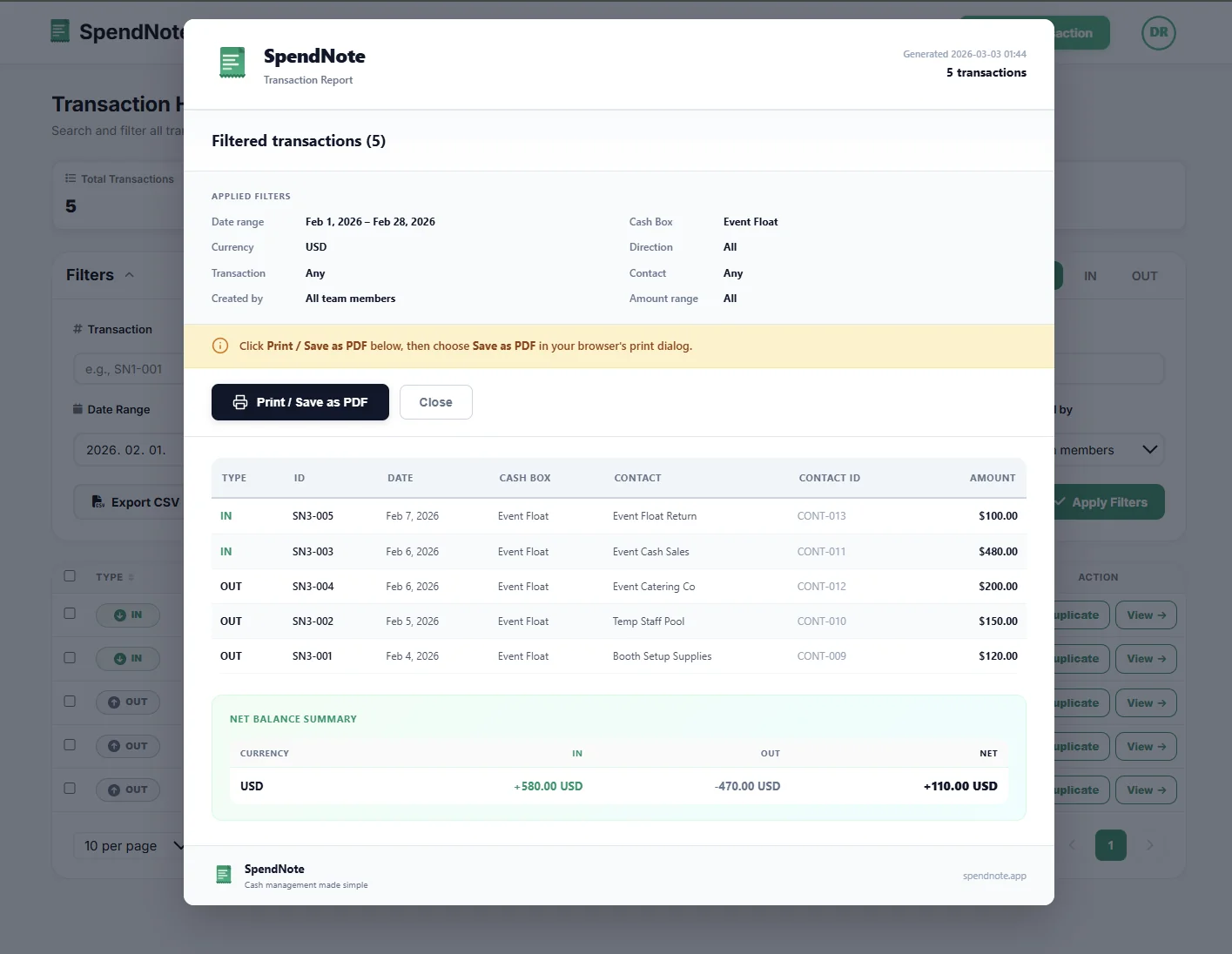
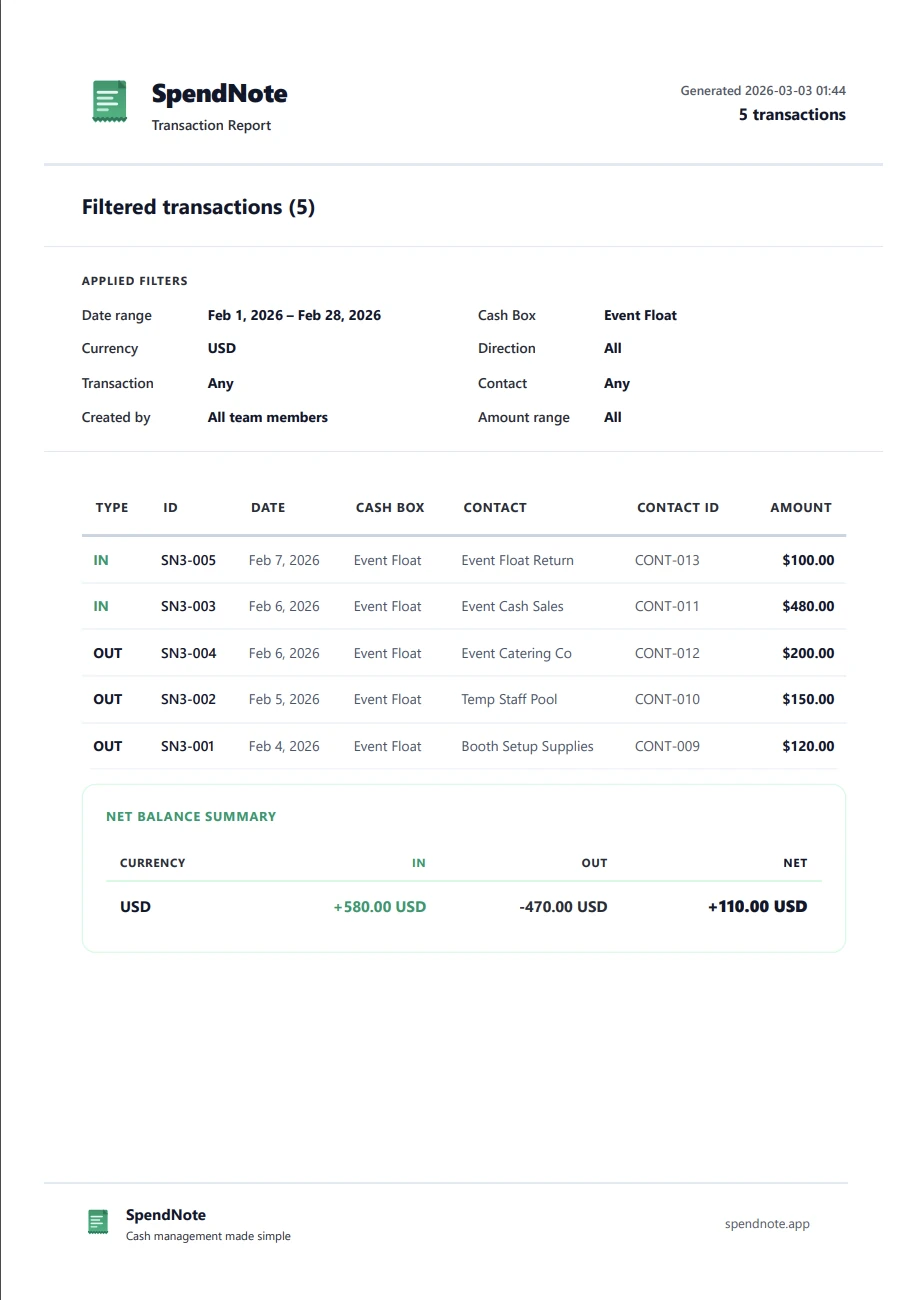
- Export filtered reports as branded PDFs — print them for the auditor in seconds
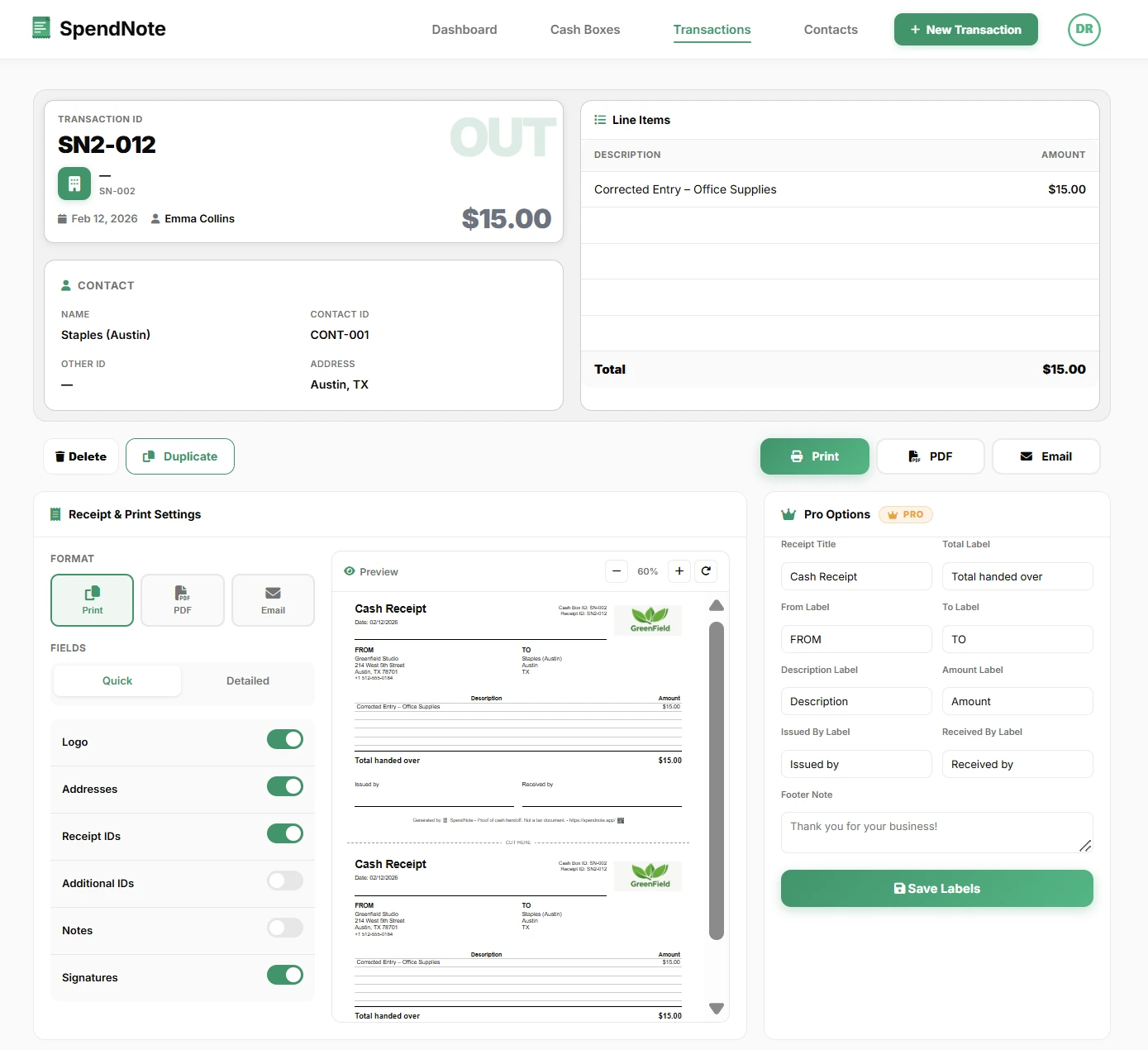
- Receipts are generated per transaction — every disbursement has a printable receipt
Every Transaction Already Receipted
Sign and print as cash moves — when audit comes, the receipts and history are already in place. 5-minute exercise instead of 5-hour scramble. Free to start, no credit card.
Start Receipt-Logging NowCommon Audit Findings (and How to Prevent Them)
- Missing receipts — The #1 finding. Prevention: generate a receipt at the time of every transaction, not after the fact.
- Unsigned disbursements — Cash left the box but nobody's name is on it. Prevention: require a contact/user on every transaction entry.
- Running balance errors — The log says $340 but the box has $280. Prevention: use auto-calculated balances instead of manual formulas.
- No separation of duties — The same person handles cash and approves disbursements. Prevention: use role-based access (admin vs user).
- Infrequent reconciliation — Problems compound when you reconcile monthly instead of weekly. Prevention: run a petty cash reconciliation at least weekly.
Important: SpendNote provides internal cash tracking and receipt generation to support your audit process. It does not replace your accounting software, tax documentation, or formal audit procedures. Use SpendNote records as supporting documentation alongside your official accounting records.
Internal Audit vs External / Tax Audit — What This Checklist Covers
This checklist is built for the internal owner-or-manager audit — the recurring weekly or monthly self-check that confirms petty cash balances, receipts are filed, and nothing has gone missing. That is the only kind of audit SpendNote helps you run.
- Internal audit (covered here): The owner, office manager, or bookkeeper periodically counts cash, verifies it matches the SpendNote balance, reviews recent transactions for unusual entries, and signs off. Operational, recurring, low-friction.
- External or tax audit (NOT covered): A formal review by your accountant, an independent auditor, or a tax authority. These follow GAAP, jurisdiction-specific accounting standards, and statutory documentation rules. SpendNote records can serve as supporting evidence for such an audit, but the audit itself runs out of your accounting system, your bookkeeper’s working papers, and your accountant’s judgement — not out of this checklist.
If you are facing an external or tax audit, talk to your accountant first. Use SpendNote’s CSV/PDF exports to give them clean operational records to work from.
Frequently Asked Questions
How often should petty cash be audited?
At minimum, once per quarter. Many businesses do a quick reconciliation weekly and a full audit monthly. The more people who handle cash, the more frequently you should audit.
What happens if petty cash doesn't balance during an audit?
A discrepancy means either a transaction wasn't recorded, a receipt is missing, or cash was taken without documentation. The first step is to review every transaction since the last balanced audit and identify the gap. With SpendNote, every transaction is timestamped and attributed to a user, so finding the break is much faster than with a paper log.
Who should conduct the petty cash audit?
Ideally, someone other than the petty cash custodian. This separation of duties is a basic internal control. In a small business, the owner or a manager who doesn't normally handle cash is the best choice.
Can SpendNote generate audit-ready reports?
Yes. SpendNote can export filtered transaction reports as branded PDFs — filtered by date range, cash box, or user. These reports include all transaction details, running balances, and are timestamped. They are designed for internal documentation, not as official accounting records.