How to Track Cash Payments
Cash is invisible the moment it changes hands — unless you write it down. Here's how to build a tracking system that actually works.
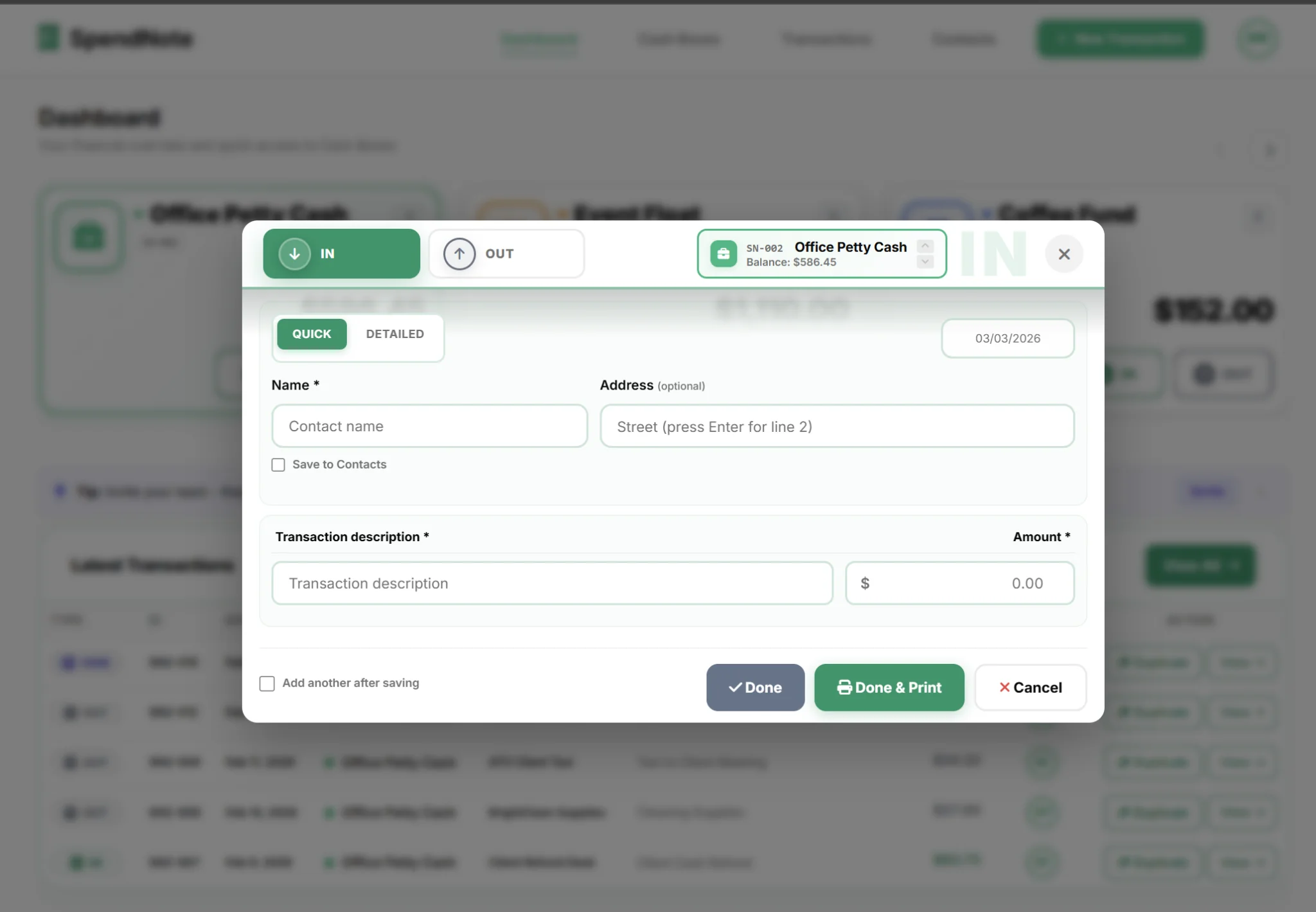
How Do You Track Cash Payments?
To track cash payments, log every transaction the moment it happens — date, amount, direction (in or out), who handled it, and what it was for. A simple running log or a digital cash tracker like SpendNote records each payment, generates a receipt, and keeps a real-time balance — so you always have proof and never lose track of where the cash went. Start tracking cash free →
Why Cash Payments Need Tracking
Bank transfers leave a trail. Credit card payments leave a trail. Cash leaves nothing — unless you create the trail yourself.
Without tracking, you can't answer basic questions: How much cash came in this week? Who did you pay and for what? Is the cash box balance correct? Where did that $200 go? These aren't edge cases. They come up every week in any business that handles cash.
Good cash tracking gives you three things: proof (a digital receipt for every payment), visibility (a real-time balance), and accountability (a record of who handled what). If you only need to track outflows, a cash paid out log is a good starting point.
What to Record for Every Cash Payment
Every cash transaction, in or out, needs these five pieces of information:
- Date and time — when the payment happened
- Amount — exact, not estimated
- Direction — money in (received) or money out (paid)
- Who — the person paying or receiving
- Purpose — what the payment was for
If you record these five things for every transaction, you have a complete cash trail. Skip any one of them, and you'll have gaps that compound over time.
Methods for Tracking Cash Payments
Paper Log
A ruled notebook or printed petty cash log template. Simple and cheap. Works for solo operators with a few transactions per week. Breaks down when you need to search, filter, export, or share with anyone. No automatic balance calculation.
Spreadsheet (Excel / Google Sheets)
Better than paper — you get formulas, filtering, and cloud access. But spreadsheets are fragile: one broken formula corrupts the balance, there's no per-user attribution, and generating receipts requires manual work. See our full comparison.
Dedicated Cash Tracking App
Purpose-built tools like SpendNote handle logging, balance calculation, receipt generation, user attribution, and report export in one place. Faster than spreadsheets, more reliable than paper, and accessible from any device — you can even manage petty cash remotely without being on-site. The investment pays for itself when you have multiple people handling cash or more than a few transactions per week.
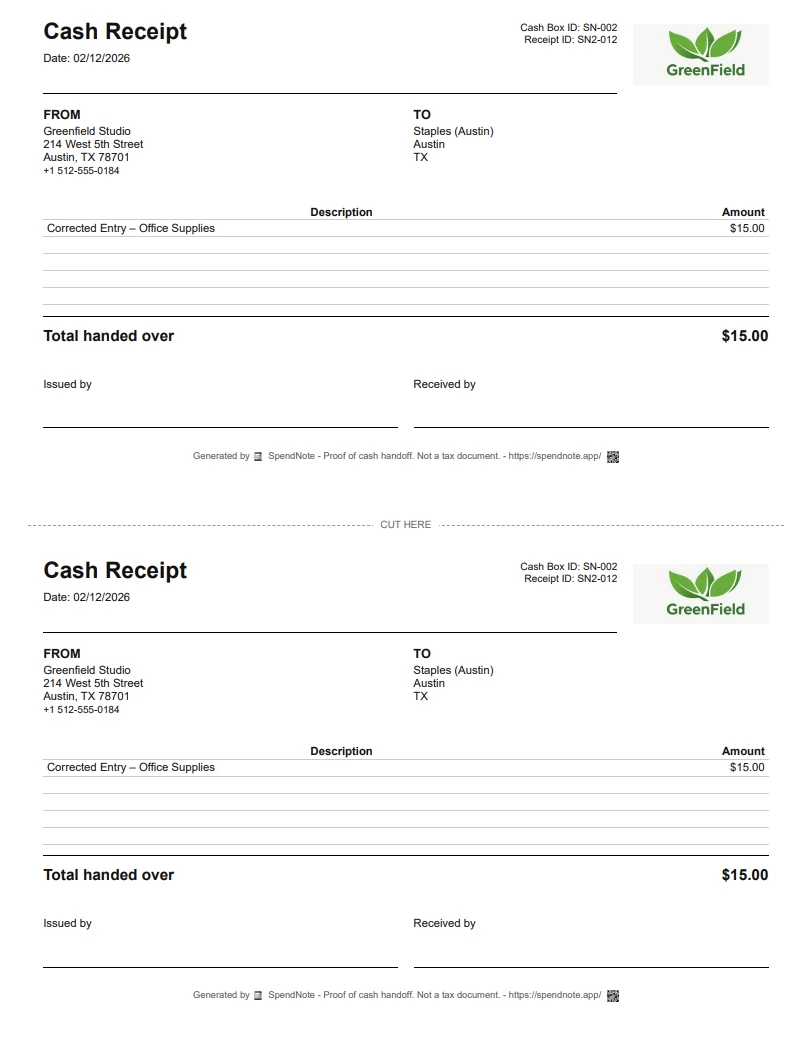
Sign and Print a Receipt for Every Cash Payment
Log the payment, sign, print — both sides keep a copy in seconds. Works on any device, no download needed. Free to start, no credit card.
Create First Cash ReceiptBuilding a Cash Tracking Habit
The system doesn't matter if people don't use it. The key to consistent cash tracking is making it fast and immediate.
- Log at the moment of payment. Not after lunch, not at end of day. The moment cash moves. With a phone-based tool, this takes 15 seconds.
- Generate a receipt every time. The receipt is both proof and discipline. When people know a receipt is created, they're more careful about amounts and descriptions.
- Reconcile regularly. Count the cash and compare to the recorded balance. Weekly is good. Daily is better if transaction volume is high. Here's how to reconcile.
- Review the log. Once a week, scan the daily reports or transaction history. Look for unusual amounts, missing descriptions, or gaps in the timeline.
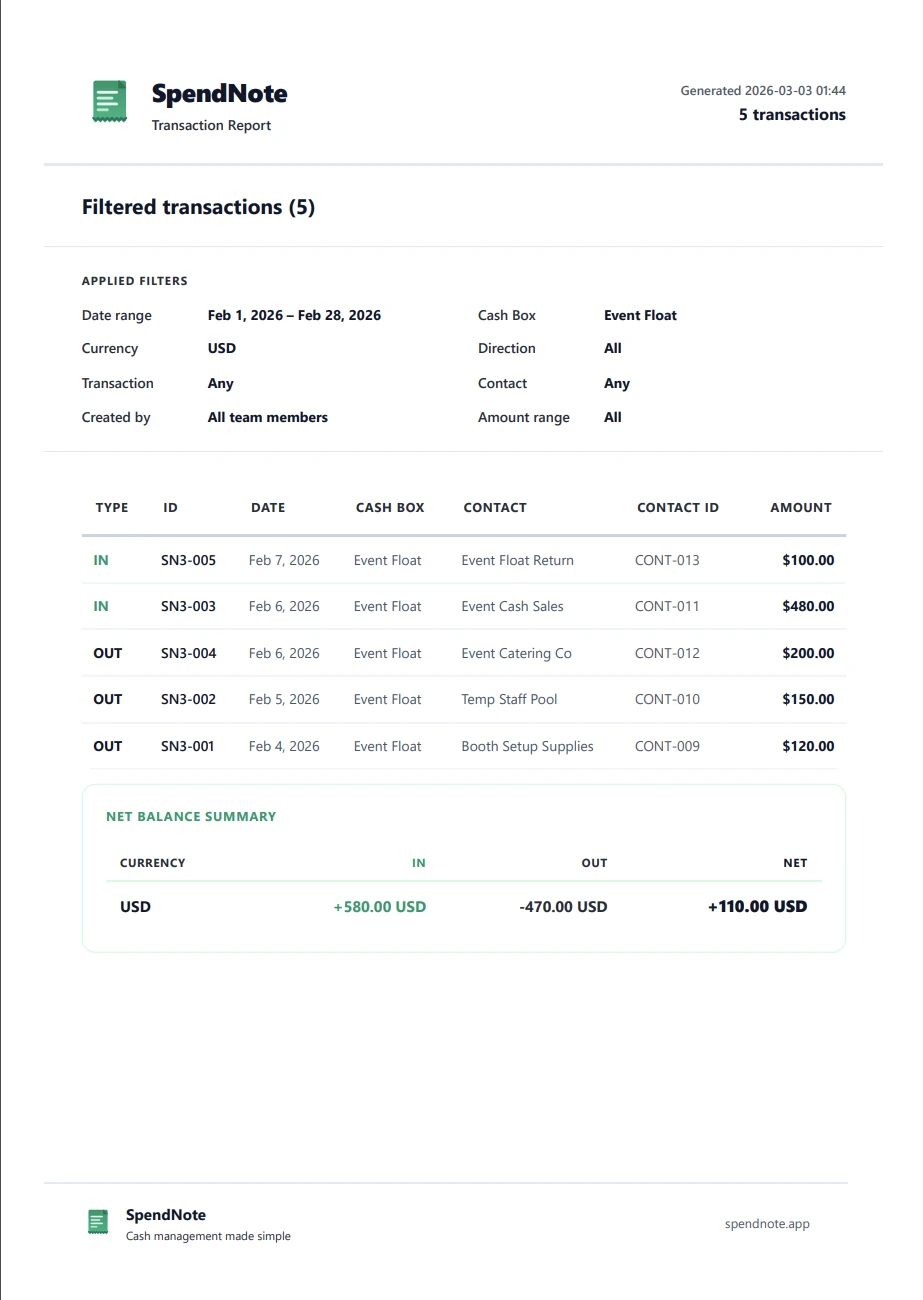
Important: SpendNote is for internal cash tracking and receipt generation. It does not replace your accounting software, POS system, or tax invoicing. Cash payment records from SpendNote serve as internal documentation alongside your official accounting system.
Frequently Asked Questions
What is the best way to track cash payments?
Record every cash payment at the moment it happens. For each transaction, log the date, amount, who paid or received, the purpose, and generate a receipt. You can use a paper log, spreadsheet, or a dedicated app like SpendNote. The method matters less than consistency.
How do I prove a cash payment was made?
Generate a receipt at the time of payment. The receipt should include the date, amount, payer, payee, and purpose. Both parties should have a copy. In SpendNote, receipts are generated automatically for every transaction and can be printed, emailed, or downloaded as PDF.
Do I need to track small cash payments?
Yes. Small payments are the ones most likely to go unrecorded, and they add up. A $5 coffee run three times a week is $780 per year. If you don't track it, that money effectively disappears from your records.
Can I track cash payments on my phone?
Yes. SpendNote works on any device with a browser — phone, tablet, or desktop. You can log a transaction in about 15 seconds, right at the moment cash changes hands. No app download required.
Try everything. Pay nothing for 14 days.
Then, if you love it
- Unlimited receipts and cash boxes
- Your logo on every receipt
- Print, PDF & CSV export
- Daily cash report with cash count
Every cash handoff, recorded and signed.
Set up in two minutes. First receipt in thirty seconds. Every entry saved and searchable.
Start my free trial