Where Should Petty Cash Be Stored?
Petty cash should be stored in a locked container with access limited to one designated custodian. The exact location — a desk drawer, office safe, or portable cash pouch — depends on your business type, but the security principles are always the same.
The Core Rule: Locked, Limited Access, Logged
Where you keep petty cash matters less than how you keep it. The three non-negotiable rules:
- Locked — the cash is in a container that physically locks. Not a cigar box. Not an envelope taped under the counter.
- Limited access — one person (the custodian) has the key or combination. If everyone can access it, no one is accountable.
- Logged — every withdrawal is documented immediately. The physical location is only half the equation — the tracking system is the other half.
If you follow these three rules, your petty cash can live almost anywhere that makes sense for your workflow.
Physical Storage Options
Metal Cash Box ($15–$40)
The most common option. A small lockable metal box with a coin tray and bill compartment. Portable, cheap, and easy to store in a drawer, cabinet, or safe. Works for any business with a float under $500. Look for one with a key lock (combination locks are slower in daily use).
Locking Desk Drawer
If your desk has a built-in lock, you can keep the cash box inside. This adds a second layer of security — someone would need both the desk key and the cash box key. The downside: desk locks are notoriously easy to pick, so do not rely on the desk lock alone for large amounts.
Small Office Safe ($50–$200)
Best for overnight storage or floats over $500. A fireproof safe bolted to the floor or wall is the gold standard. During business hours, the custodian can move the day’s working cash to a smaller box for convenience and return it to the safe at closing.
Locking Cash Pouch (Field Teams)
For construction crews, delivery drivers, or event staff working away from the office. A zippered, lockable pouch keeps the day’s cash secure during transit. The main float stays at base. Only the amount needed for that day goes out.
Best Location by Business Type
Where the cash box physically sits depends on who needs access and how often:
- Office with a reception desk — keep it in the custodian’s locked drawer or filing cabinet. Not at the front desk where visitors can see it.
- Retail shop or café — separate from the till. The cash register and petty cash should never mix. A locked box in the back office or stockroom works best.
- Construction site or workshop — in a locked toolbox, site container, or foreman’s vehicle. Rotate the day’s cash out of the main fund each morning and reconcile at end of day.
- Co-working or shared office — never leave the box in a shared space. It stays with the custodian personally or in a private locker.
- Home office (sole proprietor) — a dedicated lockable box in a home office drawer, separate from personal cash. Do not mix it with household money.
Access Control: Who Gets the Key?
The short answer: as few people as possible.
The ideal setup is a single custodian with the only key and a backup key in a sealed envelope with the owner or manager. This is sometimes called the dual control approach — one person operates the box day to day, but a second person can access it in emergencies or for audits.
If your business has multiple shifts, you have two options:
- One box, one custodian — all disbursements happen through the morning custodian. Other shifts get pre-allocated cash at handover.
- Shift-specific boxes — each shift has its own smaller float with its own custodian. This is cleaner for accountability but requires reconciliation at every shift change.
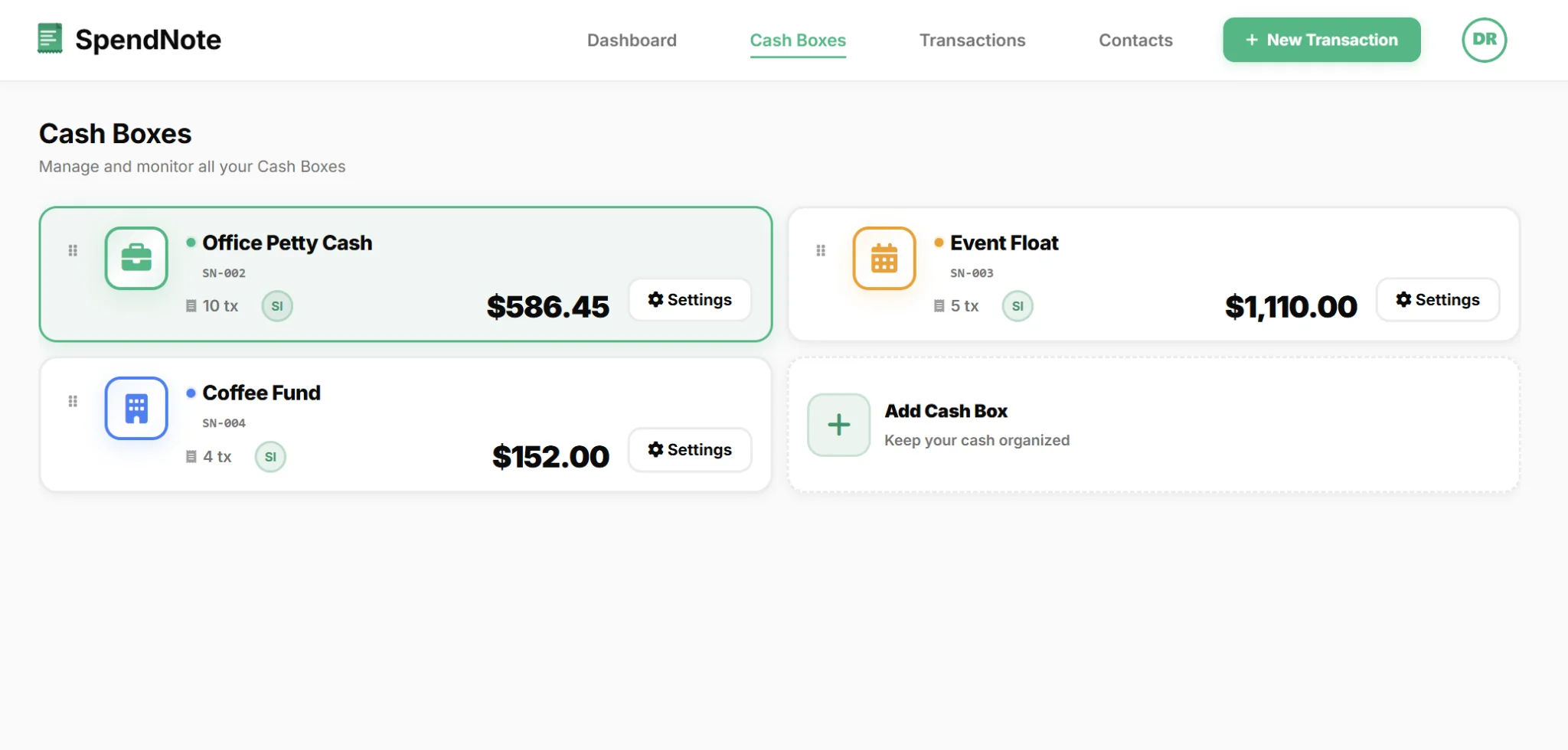
One Dashboard, All Your Cash Boxes
SpendNote lets you manage multiple petty cash boxes from one screen. Every box has its own custodian, balance, and audit trail.
Create Free AccountWhat NOT to Do With Petty Cash Storage
These mistakes sound obvious, but they happen constantly:
- Do not keep it in an unlocked drawer — this is the number-one cause of petty cash shortages. If the drawer does not lock, the cash box must have its own lock.
- Do not hide it — hiding the box behind the coffee machine or in a fake book does not replace a lock. If someone finds it, there is zero barrier to taking cash.
- Do not keep it near the cash register — petty cash and sales revenue must never mix. Different purposes, different boxes, different tracking.
- Do not leave it in an unattended vehicle overnight — for field teams, the cash goes back to base at the end of the day.
- Do not give keys to “everyone who might need it” — if four people have keys, nobody is accountable. One custodian, one key.
Petty Cash Storage Checklist
- Lockable container (metal cash box or safe)
- One designated custodian with the only key
- Backup key in a sealed envelope with the owner
- Separate from the cash register — always
- Daily log of every withdrawal and deposit
- End-of-day count and secure overnight storage
- Insurance coverage verified for cash on premises
Petty Cash Storage Policy Example
Here is a sample policy paragraph you can adapt for your own team:
Policy: The petty cash fund shall be stored in a locked metal cash box inside the office manager’s locking desk drawer. Only the designated custodian (office manager) shall hold the key to the cash box. A backup key shall be kept in a sealed, signed envelope in the company safe, accessible only to the business owner.
The cash box must remain locked when not in active use. At end of business each day, the custodian shall count the remaining cash, verify it against the daily log, and return the locked box to the desk drawer. The cash box must never be left unattended in an unlocked state.
The petty cash fund shall be kept physically separate from any cash register, sales float, or personal funds at all times.
Adjust the names, locations, and specifics for your business. The important thing is to have the rules written down — not just understood informally.
Night and Weekend Storage
During business hours, accessibility matters — the custodian needs to get to the cash quickly. After hours, security takes priority.
End-of-day routine:
- Count the remaining cash and verify it matches your log
- Lock the cash box
- Move it to a safe, locked cabinet, or locked office if it is not already in one
- Do not leave it on a desk or counter overnight, even if the office locks
If your business is closed on weekends, the cash box should be in the most secure location available — ideally a bolted safe. The amount inside should be as low as practical: replenish on Monday instead of leaving a full float idle for two days.
Important: SpendNote is for internal cash tracking and receipt generation. It does not replace your accounting software, tax filings, or insurance requirements. For high-value cash storage, consult your insurer about coverage limits.
Frequently Asked Questions
Can I keep petty cash in my desk drawer?
Only if the drawer locks and you are the sole custodian. An unlocked desk drawer is the number one cause of petty cash shortages. If the drawer does not lock, use a separate lockable cash box stored inside the drawer instead.
Should I keep petty cash in a safe?
A safe is ideal for larger floats or overnight storage, but it can slow down access during the day. Many businesses compromise: the petty cash box stays accessible during business hours and goes into the safe at night or over weekends.
Where should field teams keep petty cash?
Field teams should carry only the cash they need for that day in a lockable pouch or small cash box. The main float stays at the office. Each field disbursement should be logged immediately using a mobile tool so the trail is not lost.
Is it okay to keep petty cash at home if I work from home?
If you are a sole proprietor working from home, yes — just keep it in a dedicated lockable box separate from personal cash. For teams, petty cash should stay in the business location where expenses happen, not in someone’s home.