Petty Cash — The Short Definition
Petty cash is a small amount of physical cash a business keeps on hand for minor day-to-day expenses.
Instead of writing a check or processing a bank transfer for a $7 box of envelopes, someone opens the petty cash box, takes out $7, and logs the transaction.
The word “petty” comes from the French petit, meaning small. Petty cash is literally “small cash” — a fund for expenses too small to justify formal payment processes.
How Petty Cash Works in Practice
The system is simple. A business sets aside a fixed amount of cash — the float — in a locked box or drawer. One person is designated as the custodian. When someone needs cash for a small expense, they go to the custodian, get the money, and bring back a receipt.
Step 1: Set the Float
Withdraw a fixed amount from the bank — typically $100 to $500 depending on your team size and spending frequency. This is your starting balance.
Step 2: Assign a Custodian
One person controls the box. They hand out cash, collect receipts, and track every transaction. No custodian means no accountability.
Step 3: Log Every Transaction
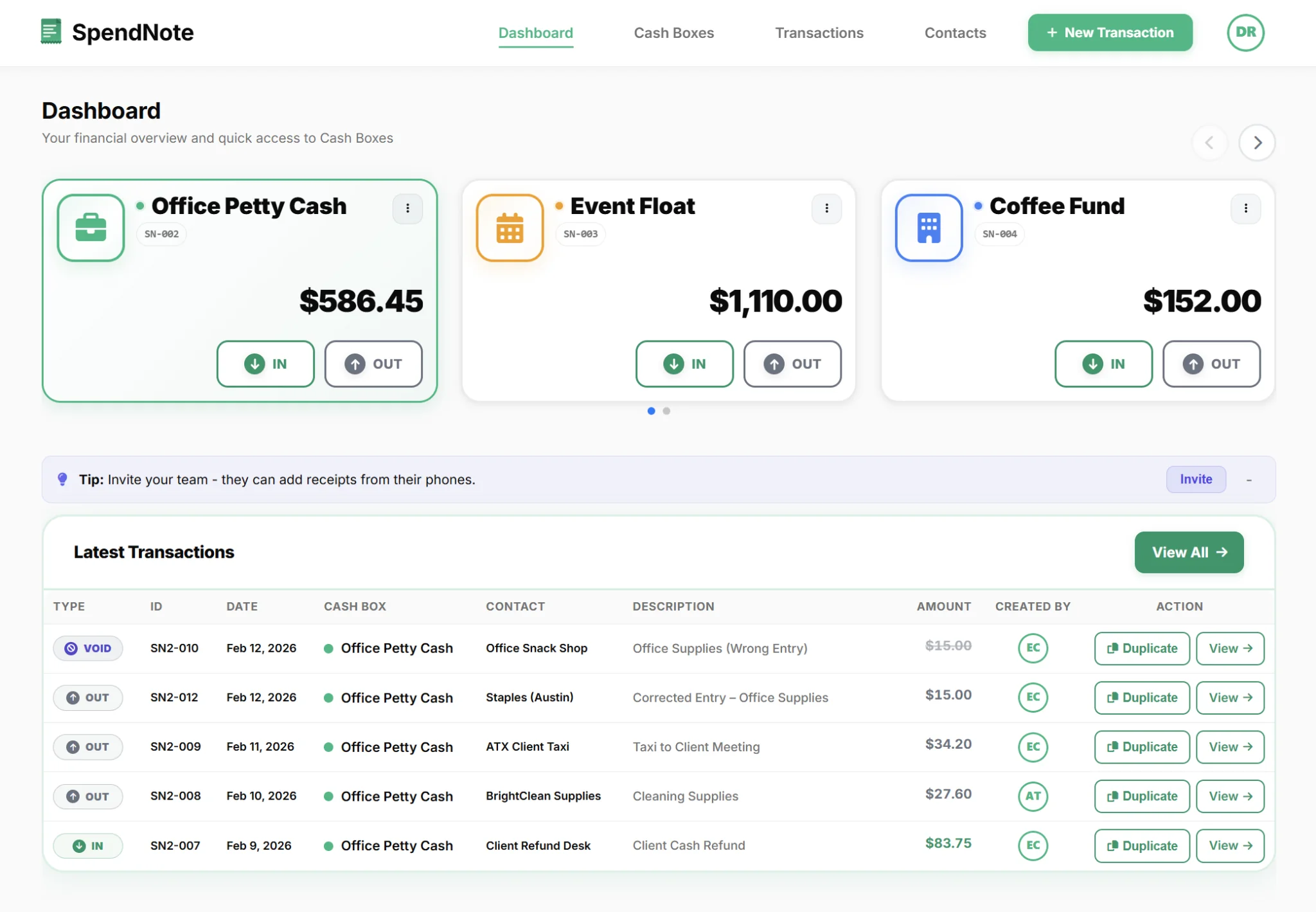
Every time cash leaves the box, it gets recorded: date, amount, what it was for, and who took it. A petty cash log or digital tracker handles this.
Step 4: Reconcile and Replenish
Periodically — weekly or monthly — the custodian counts the remaining cash, adds up the receipts, and checks that everything balances. Then the fund gets topped back up to the original float amount.
What Is Petty Cash Used For?
Petty cash covers small, routine expenses that come up during normal business operations. Common examples:
- Office supplies — pens, paper, printer ink, cleaning supplies
- Postage and shipping — stamps, courier tips, small package fees
- Parking and transportation — parking meters, tolls, taxi fare
- Meals and refreshments — coffee for a meeting, lunch for a working session
- Minor repairs — replacement light bulbs, a new power strip, duct tape
- Emergency purchases — the unexpected things that can’t wait for a purchase order
There is no universal rule for what counts as “petty.” Most businesses set their own threshold — often $50 or $75 per transaction. Anything above that goes through normal purchasing.
Petty Cash Example
Here is what a typical week of petty cash spending looks like at a small office:
| Expense | Example | Typical Amount |
|---|---|---|
| Office supplies | Pens, paper, sticky notes | $5–$25 |
| Parking | Parking meter, garage fee | $3–$15 |
| Postage | Stamps, small package shipping | $5–$20 |
| Refreshments | Coffee for a client meeting | $8–$30 |
| Minor repairs | Replacement bulbs, power strip | $5–$20 |
| Delivery tips | Courier, food delivery | $3–$10 |
Each of these is too small for a purchase order or bank transfer. Petty cash exists so these purchases happen instantly, with a receipt logged every time.
Who Needs Petty Cash?
Not every business needs a petty cash fund. You need one if:
- Your team makes small cash purchases more than once a week
- You operate in a location where card payments are not always accepted
- You have field staff, construction crews, or on-site teams that need cash for materials
- You run events, markets, or pop-ups where cash is the default payment method
You probably do not need one if all expenses go through company cards, your team is fully remote, or you can reimburse people electronically within a day.
Petty Cash vs. Other Cash Terms
People sometimes confuse petty cash with related concepts. Here’s how they differ:
Petty Cash vs. Cash Register
A cash register holds money from customer sales — revenue coming in. Petty cash is money going out to cover internal expenses. They are tracked separately and serve completely different purposes.
Petty Cash vs. Cash on Hand
“Cash on hand” is a broader accounting term for all cash a business holds, including bank accounts, registers, and reserves. Petty cash is one specific component of cash on hand — a designated fund with its own tracking system.
Petty Cash vs. Cash Float
A cash float is the starting amount placed in a register or box. In petty cash, the float is the initial funding amount. The float stays constant — when cash runs low, you replenish it back to the float amount.
Track Petty Cash the Easy Way
SpendNote replaces paper logs with automatic receipt generation, real-time balances, and a full audit trail. Set up in 30 seconds.
Create Free AccountCommon Mistakes With Petty Cash
Petty cash is simple in theory but easy to mismanage. The most common mistakes:
- No designated custodian — when everyone has access, nobody is accountable
- Skipping receipts for small amounts — $3 here and $5 there adds up to hundreds per year with zero documentation
- Never reconciling — if you don’t count the cash and check it against receipts, shortages go undetected until they are too large to trace
- Float too large — keeping $1,000 in a drawer when you spend $50 a month is unnecessary risk. Keep the float proportional to actual spending
- Mixing personal and business cash — the petty cash box is not a personal ATM. Borrowing from the box destroys the audit trail
Most of these problems disappear with a written policy and a digital tracking system that enforces documentation at every step.
How to Start a Petty Cash System
If you have decided you need petty cash, here is the quick-start path:
- Decide the float amount — estimate your monthly small-cash spending and set the float at roughly 1–2 weeks’ worth
- Get a lockable box — a metal cash box with a key, $15–$30 from any office supply store
- Assign one custodian — the person who controls access and tracks everything
- Set up tracking — a paper log, spreadsheet, or digital tracker like SpendNote
- Write a simple policy — who can request cash, the per-transaction limit, and when reconciliation happens
- Fund the box and go — withdraw from the bank, set the opening balance, and start logging
For a detailed walkthrough, see our complete how to start a petty cash box guide.
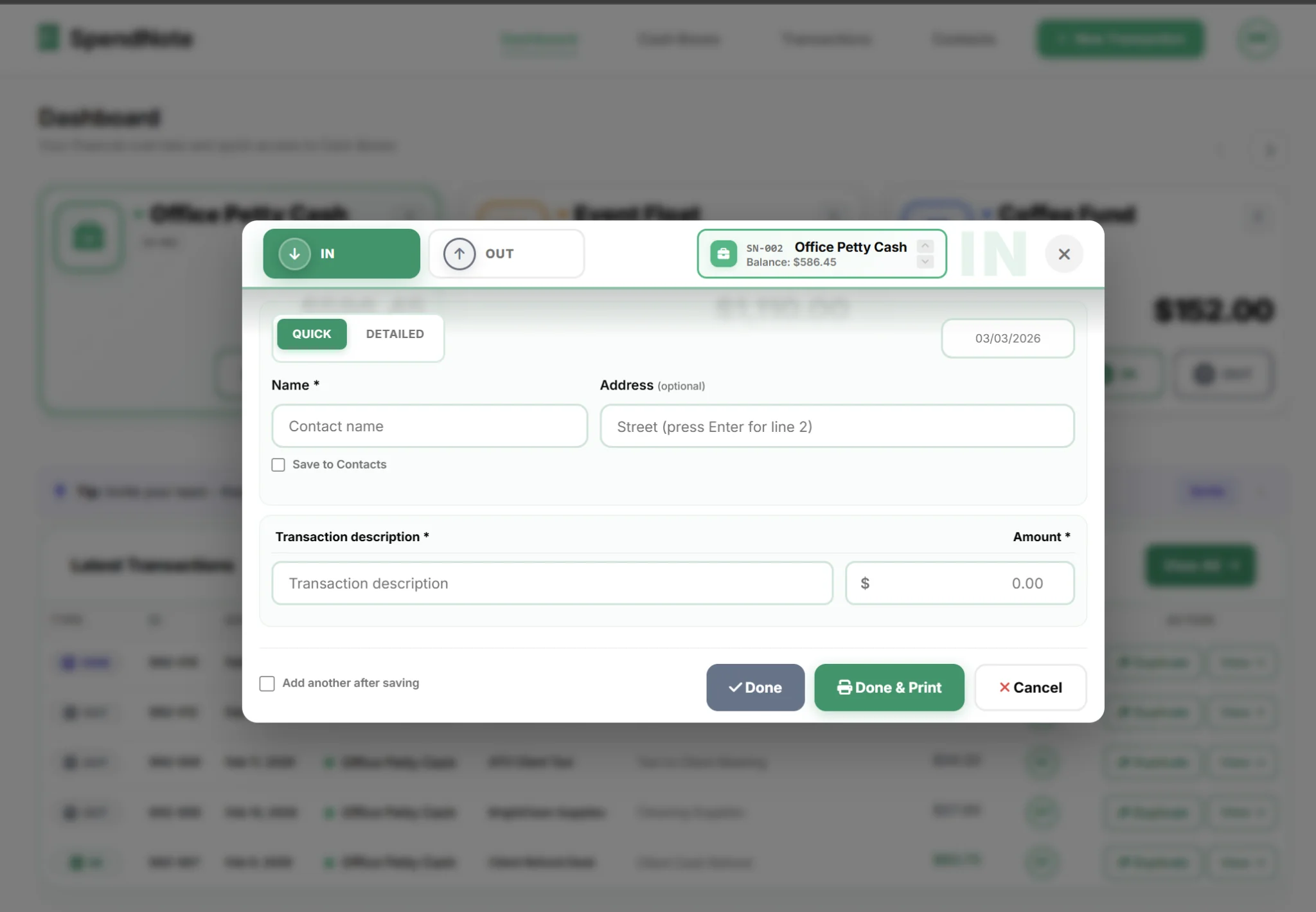
Important: SpendNote is for internal cash tracking and receipt generation. It does not replace your accounting software, tax filings, or business bank account. SpendNote documents the cash handoff — your accountant handles the rest.
Frequently Asked Questions
What is the difference between petty cash and a cash register?
A cash register handles customer payments — money coming in from sales. Petty cash is the opposite: a small fund your business keeps on hand to pay for minor expenses like supplies, postage, or parking. They serve completely different purposes.
How much money should be in a petty cash fund?
Most small businesses keep between $100 and $500. The right amount depends on how often your team makes small cash purchases. Start low, track spending for a month, and adjust. If the box runs dry every week, increase it. If it barely moves, reduce it.
Is petty cash the same as cash on hand?
Not exactly. Cash on hand is any cash your business has — including revenue, float, and reserves. Petty cash is a specific, designated fund with a fixed amount set aside for minor day-to-day expenses. It has its own tracking, its own custodian, and its own reconciliation process.
Do I need petty cash if everything is digital?
If your team never pays for anything in cash, you probably do not need it. But many businesses still encounter cash-only situations: tipping delivery drivers, buying supplies at local markets, paying for parking, or handling minor emergencies. If that happens more than once a month, a petty cash system saves time.