What Is Dual Control for Cash?
Dual control (also called a two-person rule) means two people must be present to verify a cash count. One person counts. The other observes, confirms the total, and both sign a record. Neither person can complete the process alone.
This is not about trust. It is about removing opportunity. When only one person counts cash, mistakes and manipulation are invisible. When two people count, errors are caught immediately and theft requires collusion — which is dramatically harder and rarer than solo theft.
When to Require Two-Person Counts
You do not need dual control for every single interaction with the petty cash box. That would be impractical. But there are specific moments where two-person verification is non-negotiable:
- Fund replenishment — every time new cash is added to the box, both the custodian and a second person verify the amount going in and the resulting total
- Formal reconciliation — weekly or monthly, the scheduled count that compares cash + receipts to the expected balance
- Custodian handover — when responsibility transfers from one person to another (shift change, vacation, resignation), both the outgoing and incoming custodian count together
- Discrepancy investigation — if a solo count reveals a shortage, a two-person recount is mandatory before any corrective action
- Surprise audits — an unannounced count always involves the custodian plus an independent verifier
Daily operational counts (quick end-of-day checks) can be done by the custodian alone, as long as formal dual-control counts happen at least weekly.
Who Should Be the Second Counter?
The second counter must be independent — someone with no reason to cover up a discrepancy. Good choices:
- The custodian’s direct manager — natural oversight role
- An office administrator from a different department — no conflict of interest
- The business owner — for very small teams where there are no other options
- A rotating colleague — different person each time, which prevents any two people from developing a collusive pattern
The second counter should not be:
- Someone who regularly requests cash from the box (conflict of interest)
- A close friend or family member of the custodian (compromised independence)
- Someone who has previously been involved in a cash discrepancy
The Two-Person Count Process
Step 1: Gather Materials
The custodian retrieves the locked cash box, the transaction log (or opens the digital tracker), and a blank cash count sheet. Both people are present before the box is opened.
Step 2: Open Together
The custodian unlocks the box in front of the second counter. Nobody touches the cash until both are ready. This eliminates any “I already counted before you got here” scenarios.
Step 3: First Count
The custodian counts all cash by denomination while the second counter watches. Bills are sorted and counted face-up. Coins are stacked or rolled. The total is announced and written on the count sheet.
Step 4: Second Count
The second counter independently recounts the same cash. They do not look at the custodian’s number first — they count fresh and arrive at their own total. If both totals match, proceed. If they disagree, both count again from scratch.
Step 5: Verify Against Records
Compare the agreed cash total plus all receipts and vouchers to the expected balance. If you use a digital system, the expected balance is already calculated. Note any discrepancy on the count sheet.
Step 6: Sign Off
Both people sign the count sheet with the date, the verified total, and any notes. This signed record is the legal proof that dual control was followed. File it with your petty cash records.
Sign-Off Template
Use this template for the dual-control record. Print it, or keep a digital version that both counters can sign electronically.
Date: _______________ Time: _______________
Cash Box ID / Name: ___________________________
CASH COUNT BY DENOMINATION
$100 × ___ = $______ $50 × ___ = $______
$20 × ___ = $______ $10 × ___ = $______
$5 × ___ = $______ $1 × ___ = $______
Coins: $______
TOTAL CASH COUNTED: $_______________
Total Receipts / Vouchers: $_______________
Cash + Receipts: $_______________
Expected Balance (Float): $_______________
Discrepancy: $_______________
SIGNATURES
Counter 1 (Custodian): _________________ Date: _______
Counter 2 (Verifier): _________________ Date: _______
Notes: _________________________________________________
Automate the Audit Trail
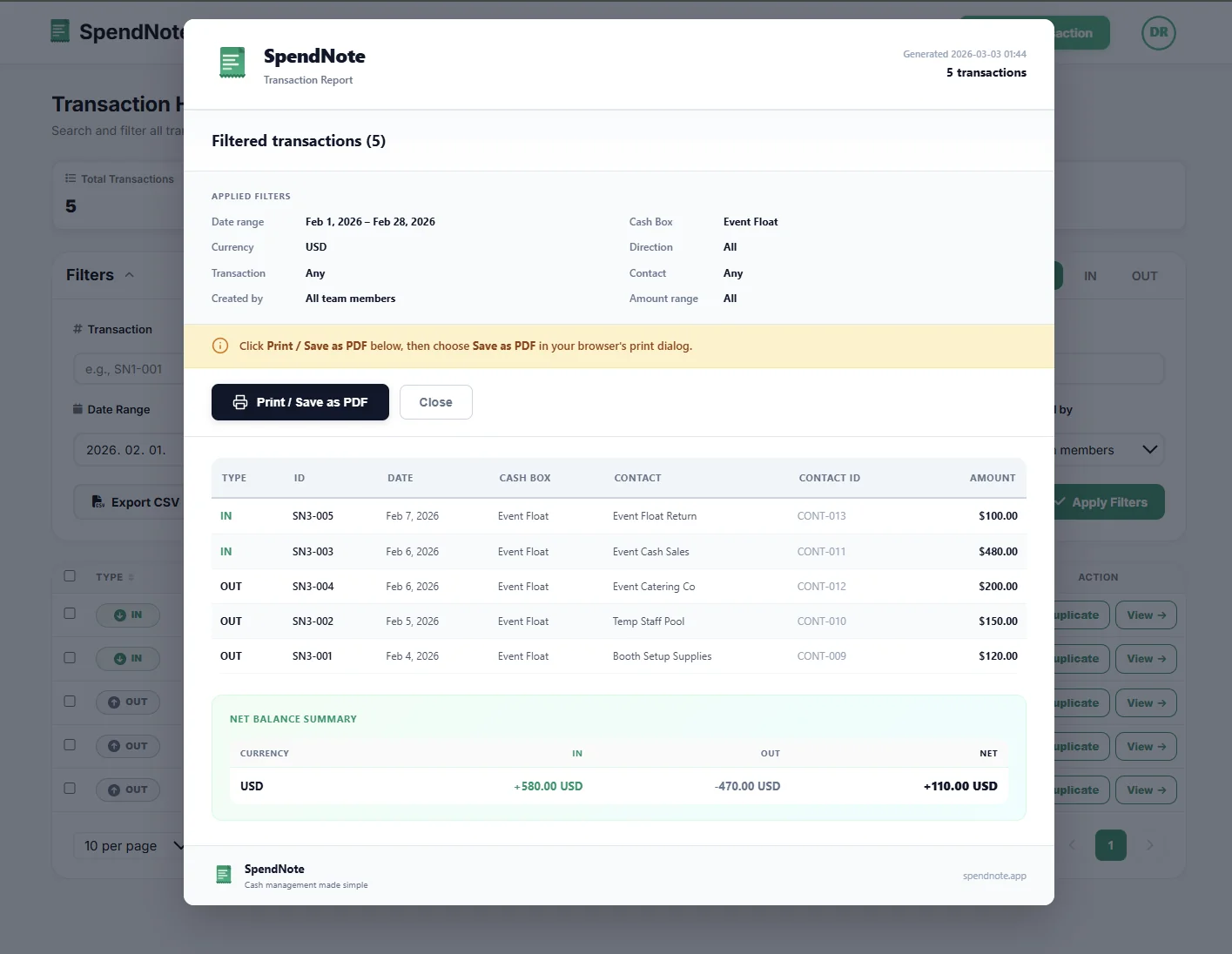
SpendNote logs every transaction with timestamps, amounts, and custodian identity. Pull reconciliation reports in seconds instead of shuffling paper.
Create Free AccountCommon Mistakes in Dual Control
- Second counter watches but does not independently count — watching is not verification. The second person must physically count the cash themselves.
- Showing the first count before the second person counts — this anchors the second counter to the first number. Count independently, then compare.
- Same two people every time — if the custodian and second counter always pair up, collusion risk increases. Rotate the second counter.
- Skipping signatures when everything balances — the paper trail matters even when there is no discrepancy. It proves the process was followed.
- Counting without the box being fully emptied — cash hidden under the tray or in an envelope inside the box gets missed. Empty the box completely before counting.
Adapting for Small Teams
If you have fewer than five employees, finding an “independent” second counter can feel awkward. Practical adaptations:
- Two-person team: the owner counts with the custodian. This is fine — the owner has the strongest incentive for accuracy.
- Solo operator: true dual control is not possible. Instead, compensate with digital logging (timestamped, immutable records), frequent self-counts, and periodic third-party spot checks (your bookkeeper or accountant).
- Remote / distributed team: if the custodian and verifier cannot be in the same room, a video call during the count is a reasonable substitute. The second counter watches the count live and confirms.
Important: SpendNote is for internal cash tracking and receipt generation. It does not replace your accounting software, tax filings, or internal audit procedures. A digital audit trail supports your dual-control process but does not replace physical verification.
Frequently Asked Questions
What is a two-person cash count?
A two-person cash count means two people independently verify the amount of cash in the box at the same time. One person counts, the other watches and confirms. Both sign a record of the count. This prevents one person from manipulating the numbers without detection.
When should I require a two-person count?
At minimum: every time the fund is replenished, during formal reconciliations, and whenever the custodian changes. Many businesses also require it for any count that reveals a discrepancy, or as part of monthly audits. Daily counts can usually be done by the custodian alone if formal dual-control counts happen weekly.
Who should be the second counter?
Someone who is not the regular custodian. Typically a manager, supervisor, or a colleague from a different department. The key requirement is independence — the second counter should have no reason to cover up a discrepancy. Rotating the second counter periodically adds another layer of integrity.
What if the two counters disagree on the amount?
Both count again independently. If they still disagree, a third person counts. The final agreed amount is recorded with a note explaining the discrepancy. Never average the two counts or pick the higher number — count until both people agree on the exact same figure.