How Much Petty Cash Should You Keep? (Quick Answer)
Most small businesses keep between $100 and $500 in petty cash. The right amount depends on your weekly cash spending and how often you replenish. The simple formula is: weekly cash spending × weeks between replenishments × 1.25 buffer. A typical office float is $150–$300 (replenished bi-weekly); a busy retail shop or café runs $200–$500 (weekly).
Petty Cash Float Formula
There is no universal “correct” amount. The right float depends on one thing: how much cash your team actually spends between replenishments.
Float = Weekly Cash Spending × Weeks Between Replenishments × 1.25
Multiply your average weekly petty cash spending by the number of weeks between replenishments. Then add a 25% buffer for unexpected expenses. This gives you a float that is large enough to avoid running dry but small enough to minimize risk.
Example: Your team spends about $60 per week on small cash purchases. You replenish every two weeks. The formula gives: $60 × 2 × 1.25 = $150. Round up to $150 or $200 for clean denominations.
If you do not know your weekly spending yet, start with an estimate, track for one month, then recalculate with real data.
$100 Petty Cash Float Breakdown (Suggested Denominations)
If you are setting up a $100 float, here is a practical denomination mix that handles most small purchases without constant change-making. The goal: enough $1s and $5s to make change for typical $5–$30 purchases.
| Denomination | Quantity | Subtotal |
|---|---|---|
| $20 bill | 1 | $20 |
| $10 bill | 3 | $30 |
| $5 bill | 5 | $25 |
| $1 bill | 20 | $20 |
| Coins (mixed) | — | $5 |
| Total float | — | $100 |
For a $200 float, double the bill counts and keep coins around $5–$10. For a $500 float, add four to five $20 bills on top of the $200 mix — you rarely need anything larger than a $20 in petty cash, since bigger purchases should go on a card or invoice.
Tip: Whatever the breakdown, log every withdrawal and return as it happens. The float only stays accurate if every movement is recorded — ideally with a cloud petty cash tool that timestamps and attributes each transaction.
Typical Amounts by Business Type
| Business Type | Team Size | Typical Float | Replenishment |
|---|---|---|---|
| Solo freelancer / home office | 1 | $50–$100 | Monthly |
| Small office (admin, marketing) | 3–10 | $150–$300 | Bi-weekly |
| Retail shop or café | 5–15 | $200–$500 | Weekly |
| Construction / field crew | 5–20 | $300–$750 | Weekly |
| Event / catering company | 10–30 | $500–$1,000 | Per event |
| Nonprofit / community org | 2–10 | $100–$300 | Bi-weekly |
These are ranges, not rules. A construction crew that buys all materials on account may need less than a three-person office that pays cash for daily parking and supplies. Use the formula with your actual numbers — the easiest way to get them is a digital petty cash book that logs every withdrawal as it happens.
Signs Your Float Is Too High
- More than 60–70% of the float remains at replenishment time — you are keeping cash that sits idle and creates unnecessary risk
- The same bills stay in the box for weeks — if the same $20 bill is still there after three replenishment cycles, the float is too large
- You feel nervous about the amount in the box — if losing the box would cause real financial pain, reduce the float
- Insurance does not cover the amount — many business policies cap cash theft at $200–$500. If your float exceeds your coverage, reduce it or increase your coverage
Fix: Reduce the float by 25–50%. Track for two weeks. If the box still does not run dry, reduce again. Keep going until the float matches actual spending.
Signs Your Float Is Too Low
- The box runs dry before the scheduled replenishment — people need cash and there is none, so they use personal money and seek reimbursement (which defeats the purpose of petty cash)
- Emergency replenishments happen regularly — if you are making unscheduled bank trips to top up the box, the float is too small
- Staff stop using the system — if the box is always empty, people give up on it and pay out of pocket without logging anything. You lose visibility completely.
Fix: Increase the float by 25–50% and shorten the replenishment cycle. If the box runs dry every week, either double the float or replenish twice a week.
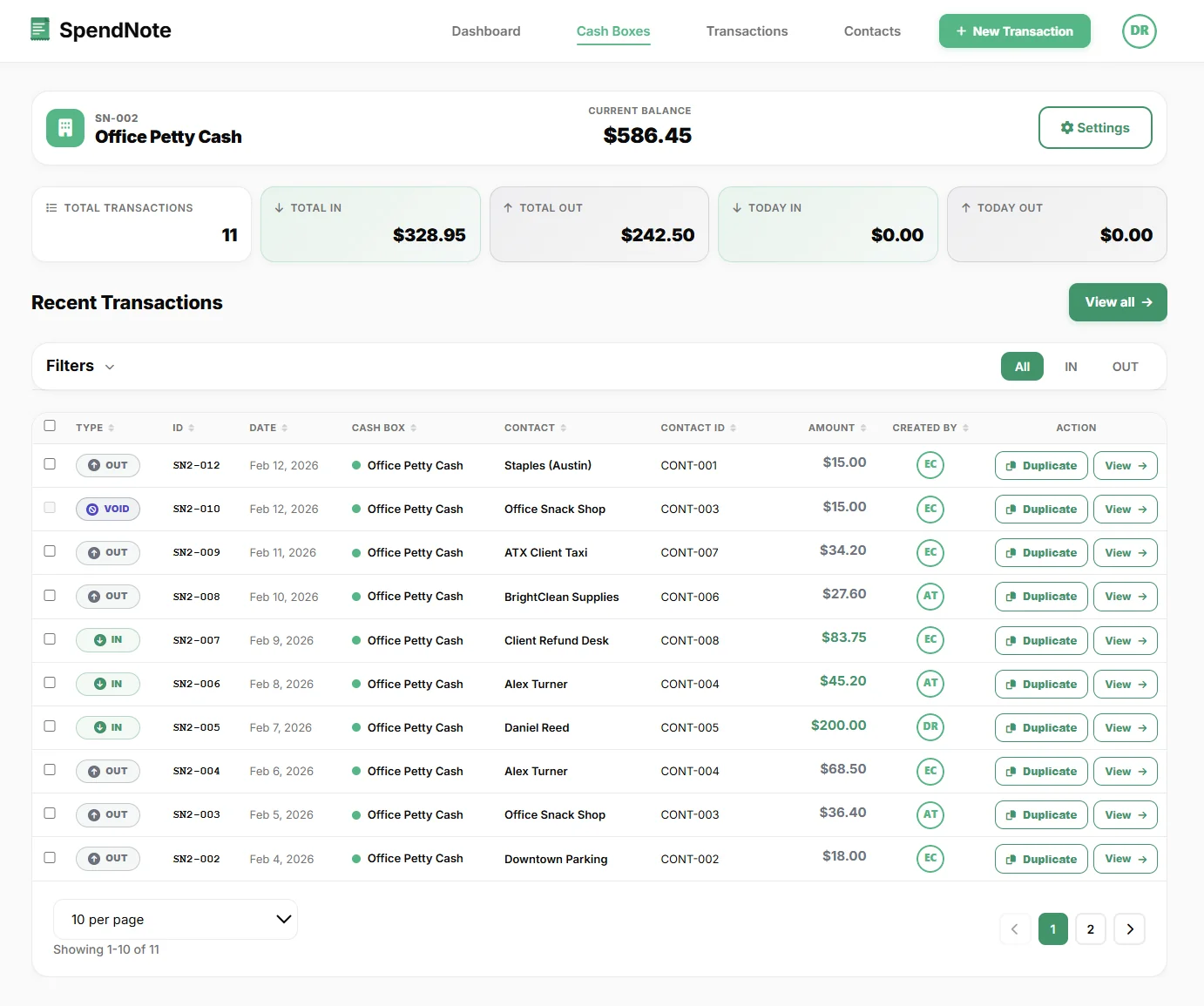
See Your Real Float Need in One Week
Log every petty cash transaction as it happens — print a receipt, keep a copy. After a week, the real spending pattern tells you the right float. Free to start, no credit card.
Create First ReceiptWhen to Adjust the Float
Your float is not a set-it-and-forget-it number. Review it quarterly and adjust when circumstances change:
- Team grows or shrinks — more people means more small expenses. Fewer people means less spending.
- Seasonal spikes — holiday season, summer events, end-of-year projects. Temporarily increase the float for busy periods, then reduce it when things normalize.
- New expense patterns — if the team starts buying lunch supplies or the office moves to a location with paid parking, spending patterns change.
- You switch from cash to card for some expenses — if supplies now go on a company card, petty cash spending drops and the float should shrink.
- Policy changes — raising or lowering the per-transaction limit directly affects how much cash flows through the box.
The Denomination Mix
Once you know the total float, break it into denominations that make the custodian’s life easy. The goal: be able to make change for any common purchase without large bills.
Recommended Mix for a $300 Float
5 × $20 = $100
5 × $10 = $50
10 × $5 = $50
20 × $1 = $20
Quarters: $10 (1 roll)
Dimes: $5 (1 roll)
Nickels: $2 (1 roll)
Remaining: adjust $20s up or down to reach $300
For a $150 float, halve the quantities. For a $500 float, add more $20s and $10s. Avoid $50 and $100 bills — most petty cash purchases are under $30, and large bills create change problems.
Float vs. Per-Transaction Limit
These are two different numbers. The float is the total amount of cash in the box. The per-transaction limit is the maximum amount anyone can take out in a single withdrawal — typically $50 to $75.
Both should be defined in your petty cash policy. A high float with a low per-transaction limit is fine — it just means the box lasts longer between replenishments. A low float with a high per-transaction limit is risky — two large withdrawals can empty the box.
Important: SpendNote is for internal cash tracking and receipt generation. It does not replace your accounting software, tax filings, or insurance requirements. Consult your insurer about cash-on-premises coverage limits when sizing your float.
Frequently Asked Questions
What is the average petty cash amount for a small business?
Most small businesses with fewer than 20 employees keep between $100 and $500. The median is around $200 to $300. Businesses with field teams, frequent supply runs, or cash-heavy operations may keep $500 to $1,000. The right number is not the average — it is the amount that covers your actual spending between replenishments.
How do I know if my float is too high?
If your petty cash box still has more than 60 to 70 percent of the float at replenishment time, the float is probably too high. Excess cash in the box is excess risk — it increases the potential loss from theft and ties up money that could be in the bank earning interest or covering other expenses.
Should I increase the float for busy seasons?
Yes. If your business has predictable busy periods — holiday season, event weeks, construction deadlines — temporarily increase the float to cover the spike in small expenses. Reduce it again when the busy period ends. Do not leave a seasonal float in place year-round.
Is $100 too little for petty cash?
Not necessarily. If your team makes only a few small cash purchases per week totaling under $40, a $100 float is fine. The goal is to have enough cash to cover spending between replenishments without running dry. If $100 lasts two weeks, it is the right amount.