Petty Cash Custodian
The single most important petty cash decision isn’t which cash box to buy or what float to start with — it’s who is responsible. The custodian is the one person who controls the cash, keeps the records, and is accountable when something doesn’t add up.
Quick answer: A petty cash custodian is the one designated person who controls the petty cash fund — they hold the only key, disburse cash against approved requests, collect a receipt for every transaction, keep the log, and reconcile the fund on a fixed schedule. One custodian, one key, one log. When everyone has access, no one is accountable.
What Is a Petty Cash Custodian?
A petty cash custodian is the person inside your business who is officially responsible for the petty cash fund. They are not the bookkeeper, not the approver, not the auditor — they are the operational owner of the cash box on a day-to-day basis.
The role exists because petty cash is, by nature, the easiest money in the business to lose. It is physical, it is small-bill, and it moves in unpredictable amounts. Without a single accountable person, it disappears in $5 and $10 increments until the float is short by $200 and nobody can explain why.
Other names for the same role: petty cash keyholder, petty cash manager, cash box owner. The job is the same regardless of the title.
Why You Need ONE Designated Custodian
The single most common structural cause of petty cash shortages is shared access. Three people can all open the box. Each one assumes the other two recorded their transaction. Nobody did. By the end of the month, the cash is short by $80 and the log is missing six entries.
One custodian solves this in a single sentence: if cash is short, there is exactly one person to ask. That person can either explain the gap or escalate it. There is no “I thought Sarah took it” or “Mike said he’d log it later.”
The principle is universal. Every published petty cash policy — from small business templates to university finance manuals to corporate internal control guides — insists on the same rule: one custodian, one key, one log.
Who Should Be the Petty Cash Custodian?
The right person is not necessarily the most senior. They need a specific mix of qualities:
Selection criteria
- Trustworthy. Goes without saying. Cash plus opportunity equals risk — the custodian has both.
- Organized and detail-oriented. Forgets nothing, files receipts immediately, can spot when the log doesn’t balance.
- Regularly on-site during business hours. A part-time custodian creates gaps. Pick someone who is there when cash is needed.
- Comfortable enforcing rules. Will say “I need a receipt before I give you the cash” — even to the boss. If they can’t, the policy collapses.
- Available for handover. When they go on holiday, someone else has to step in. The custodian must be willing and able to do a clean handover.
In practice, the most common choice in small businesses is the office manager, a senior administrative team member, or a trusted operations lead. In a 5–15 person company, this is usually obvious within a few minutes of asking the question.
What the Custodian Actually Does — Day-to-Day Responsibilities
The role is part-time in hours but full-time in accountability. Here is what the job looks like in practice:
Daily — whenever cash moves
- Open the cash box only when there is an approved disbursement request.
- Verify the request matches your petty cash policy (allowed expense category, under the maximum single transaction limit).
- Disburse the cash and immediately fill in or generate a petty cash voucher with amount, date, recipient, and purpose.
- Get a signature from whoever received the cash.
- Record the transaction in the log (paper, spreadsheet, or a digital tool like SpendNote — consistency matters more than the format).
- File the voucher and any expense receipt in the box.
End of day
- Quick count: cash on hand + receipts in the box should equal the float.
- If the count matches, lock the box and put it in its secure location.
- If the count is off, log the discrepancy now — not tomorrow. Same-day investigation finds gaps that next-day investigation never will.
Weekly
- Reconcile properly — physical cash count, log review, missing-receipt check.
- Flag any unusual patterns (round-number disbursements, vague descriptions, frequent small shortages from the same shift).
- Check whether the float is running low; if so, prepare a replenishment request.
When the fund is replenished
- Total all vouchers since the last replenishment.
- Submit the vouchers to the bookkeeper or accountant for a top-up.
- Put the replenishment cash into the box, bringing the balance back to the original float.
- Both the custodian and the approver sign off — this is a key dual-control checkpoint.
Who Should NOT Be the Custodian
This is the part most small businesses get wrong. The custodian role exists inside a system of checks — if one person controls multiple parts of that system, the controls collapse.
The same person should not be both:
- The custodian and the approver. The person disbursing cash should not also be the person who authorises replenishments. Otherwise they can effectively replenish their own activity without independent review.
- The custodian and the bookkeeper. The person handling the cash should not also be the person reconciling the books to the bank. A second pair of eyes catches what the first pair misses (or hides).
- The custodian and the auditor. Nobody audits their own work. The reconciliation review — even if it’s informal — should involve a different person.
The reality in small teams: sometimes there are not enough people to fully separate every function. In that case, at minimum the review of the reconciliation should be done by someone other than the custodian. Even an owner who spot-checks the log once a month is better than the custodian reviewing themselves.
How SpendNote Helps the Custodian
SpendNote is purpose-built for the custodian’s daily workflow. Every transaction generates a receipt with amount, date, recipient, and a unique number — all in under 30 seconds. The log is the transaction history; the reconciliation balance is calculated automatically as you go.
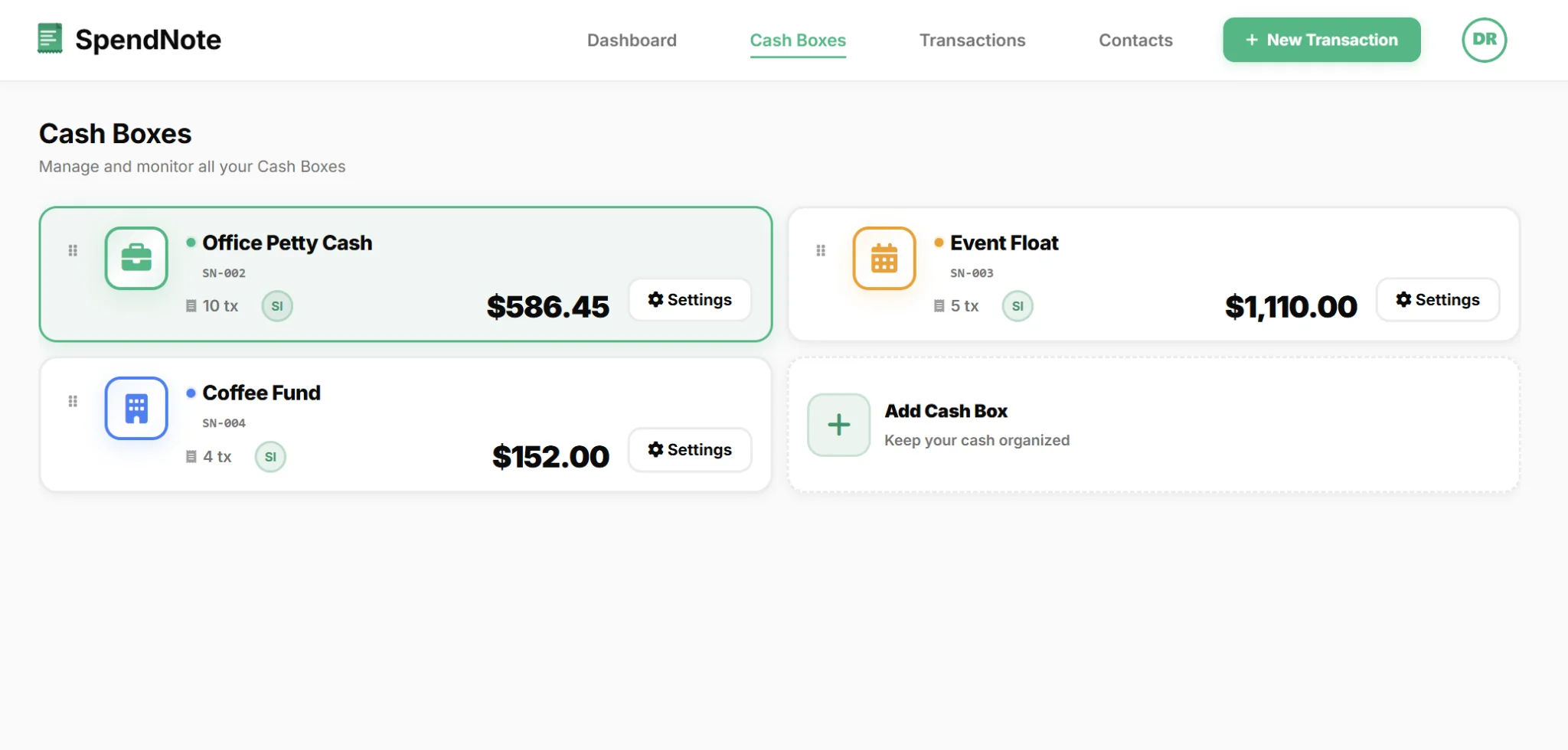
Specifically for the custodian role:
What SpendNote handles for the custodian
- Per-transaction receipts — print, PDF, or email, with amount, date, recipient, purpose, and unique receipt number
- Live float balance — cash + receipts always reconciles automatically
- Per-user attribution — if more than one person ever touches the cash, every transaction is tagged with who logged it
- Searchable transaction history — filter by date, person, amount, or cash box
- Branded PDF reports — for the weekly reconciliation review and audit trail
- Multi-cash-box support — one custodian can manage several funds without mixing them up
The point is not to replace the custodian. The point is to give them the tooling so the documentation never lags behind the cash.
When the Custodian Changes — The Handover
Custodians leave, go on holiday, or get reassigned. A clean handover is the difference between a smooth transition and a permanent “I never got that” argument three months later.
- Outgoing custodian reconciles first. Cash plus receipts must equal the float. Any open discrepancy is closed (or formally logged) before the handover.
- Both sides count together. The outgoing and incoming custodian count the cash side by side, exactly like a two-person cash count.
- Both sign the handover record. Date, time, verified total, signatures from both. This is the moment of transfer of responsibility — everything before is on the outgoing custodian, everything after is on the incoming one.
- Hand over the keys physically. Including spare keys. Including any access codes. Nothing stays with the previous custodian.
- Walk through any open items. Outstanding vouchers waiting for receipts, pending replenishments, anything mid-process — the incoming custodian needs to know about it before day one.
If you use SpendNote, the user account is reassigned at the same time the keys change hands — so the digital trail follows the physical handover, with no gap.
Auto-Receipts, Auto-Balance, Auto-Attribution — The Custodian Just Counts Cash
Every transaction signed, both sides keep a copy, balance calculates itself. Free to start, no credit card.
Make Custodian's Job EasierFrequently Asked Questions
What is a petty cash custodian?
A petty cash custodian is the one designated person who is responsible for the petty cash fund. They control physical access to the cash box, approve and disburse small amounts, collect receipts for every transaction, keep the log, and reconcile the fund on a regular schedule. The custodian is the single point of accountability for the cash and its records.
Who should be the petty cash custodian?
A trustworthy, organized, detail-oriented person who is regularly available during business hours — typically an office manager, bookkeeper’s assistant, or a senior team member. They should follow instructions carefully, document every transaction immediately, and feel comfortable saying no to disbursements that don’t fit the policy. Avoid appointing the same person who also approves replenishments or reconciles the books — that breaks separation of duties.
Can the same person be both the custodian and the approver?
No — that breaks the basic internal control. The custodian disburses and records cash; a different person should approve replenishments and review the reconciliation. In small teams where two people aren’t always practical, a second person should at least review and sign off on the reconciliation periodically. One person controlling both sides is the most common structural cause of petty cash discrepancies.
What does a petty cash custodian do every day?
Day to day, the custodian opens the box only when needed, disburses cash against an approved request, fills in (or generates) a receipt with the amount, date, recipient, and purpose, files the receipt, and updates the log. End of day, they do a quick count and confirm the balance still matches the records. They also flag missing receipts, unusual amounts, or any access by someone else.
What happens when the petty cash custodian changes?
Before the handover, the outgoing custodian reconciles the fund — cash plus receipts must equal the float — and prints or saves the latest log. The outgoing and incoming custodian then count the cash together, both sign a handover record stating the verified total, and the keys are physically handed over. The incoming custodian reviews any open vouchers and outstanding receipts so nothing is lost in the transition.
Try everything. Pay nothing for 14 days.
Then, if you love it
- Unlimited receipts and cash boxes
- Your logo on every receipt
- Print, PDF & CSV export
- Daily cash report with cash count
Every cash handoff, recorded and signed.
Set up in two minutes. First receipt in thirty seconds. Every entry saved and searchable.
Start my free trial